Written by: Dr. Chirranjiv Chabraa (MBBS, MD in Dermatology, Venerology, and Leprology )
Clinic: Alive Wellness Clinics, Delhi
Setting up a new aesthetic clinic is one of the most capital-intensive decisions a dermatologist or plastic surgeon will make outside of their own education. The wrong device mix means underutilised equipment sitting idle, cash locked up in machines that do not match your patient demographic, and missed revenue from treatments you cannot offer.
The right device mix, chosen in the right order, builds a clinic that generates revenue from week one and grows into a full-service aesthetic practice over time.
This guide covers every core equipment category you need to consider laser hair removal machines, HIFU, hydrofacial, RF microneedling, CO2 fractional laser, and tattoo removal with clinical context and practical buying considerations for each. It is written specifically for dermatologists, plastic surgeons, and cosmetic physicians setting up or expanding an aesthetic practice in India.
Why Equipment Selection Is a Clinical and Business Decision
Most equipment guides treat device selection purely as a purchasing question. It is not. The machines you choose define your treatment menu, your patient experience, your consumable costs, your staff training requirements, and your clinic’s positioning in the market for the next five to seven years.
A dermatologist opening a clinic in a metro city with a young, urban patient base will make different choices than a plastic surgeon expanding into a Tier 2 city. The clinical indications overlap but the demand patterns, price sensitivity, and treatment frequency vary significantly.
Before you evaluate any device, define three things:
Your core patient demographic. Age range, skin type distribution across Fitzpatrick scale, income bracket, and primary aesthetic concerns. These determine which treatments will generate your highest volume.
Your treatment menu priorities. The services you want to lead with versus the services you want to add as the clinic scales. Not every device needs to be purchased at launch.
Your budget sequencing. Which devices generate revenue fastest, which build long-term differentiation, and which can wait until the clinic is profitable. This determines purchase order, not just total spend.
With those three answered, here is how to evaluate each equipment category.
1. Laser Hair Removal Machines, The Non-Negotiable Starting Point
Laser hair removal is the single highest-volume aesthetic treatment in India. Demand is consistent across age groups, skin types, and cities. It generates repeat visits most patients require six to eight sessions which means predictable, recurring revenue from a single patient relationship.
No new aesthetic clinic should open without laser hair removal capability. The only question is which technology to start with.
Diode Laser Hair Removal Machines
The diode laser hair removal machine is the workhorse of the category. Operating at 810nm, diode lasers offer effective melanin absorption across a broad range of skin types, making them suitable for the majority of Indian patients across Fitzpatrick types III to V.
What to look for when buying a diode laser machine:
- Spot size: Larger spot sizes (18x18mm or above) treat larger body areas faster, reducing treatment time and increasing your patient throughput per hour.
- Repetition rate: Higher repetition rates (10Hz and above) mean faster treatment delivery. For full-body treatments, this directly affects how many patients you can see per day.
- Contact cooling: Integrated contact cooling is non-negotiable for darker skin types. It protects the epidermis while the laser targets the follicle. Sapphire contact cooling is the current standard.
- Wavelength options: Some diode systems offer dual or triple wavelength combinations (755nm + 810nm + 1064nm). These expand your treatable skin type range and are worth considering if budget allows.
Buying consideration: A single-wavelength 810nm diode is the right first choice for most new clinics. It covers the majority of your patient population at a lower entry cost than multi-wavelength systems. Add broader wavelength capability when you scale.
Price range (India): Entry-level diode laser machines from verified distributors start at approximately INR 8–15 lakh. Medical-grade systems with larger spot sizes and higher repetition rates range from INR 20–40 lakh. Always verify CE marking and check whether the distributor provides on-site training and a service contract.
Alexandrite Laser Systems
The alexandrite laser operates at 755nm, placing it at a wavelength with higher melanin absorption than diode. This makes it highly effective for lighter skin types Fitzpatrick I to III but limits its safe use on darker Indian skin tones without careful parameter management.
When to choose alexandrite over diode:
If your clinic is in a metro market with a significant lighter-skinned patient population, or if you plan to serve international patients, an alexandrite system as your second laser (after an established diode) gives you clinical precision for that demographic. Alexandrite also treats finer, lighter hair more effectively than diode at standard settings.
Alexandrite laser hair removal for combination practices: Some practitioners prefer combination systems that offer both alexandrite (755nm) and Nd:YAG (1064nm) in a single device. This covers the full Fitzpatrick range — I through VI — in one platform.
Buying consideration: Alexandrite is rarely the right first choice for a new Indian aesthetic clinic unless your specific patient demographic clearly skews toward lighter skin types. Invest in diode first. Add alexandrite when your volume justifies a second laser platform.
Pico Laser Machines, Beyond Hair Removal
The pico laser machine operates in picosecond pulse durations, making it functionally different from both diode and alexandrite systems. Its primary clinical applications are pigmentation treatment, tattoo removal, and skin rejuvenation not hair removal.
However, pico lasers are worth considering as a second or third device for one important reason: versatility. A clinic with a pico laser can offer laser hair removal (in some configurations), tattoo removal, melasma treatment, carbon peels, and skin brightening treatments from a single platform. This is meaningful ROI justification when the initial cost is INR 25–60 lakh.
Buying consideration: Pico laser makes sense for clinics that want to offer pigmentation and tattoo-related services alongside hair removal, and have the patient volume to justify the premium price point. It is not the right starting device for a clinic opening on a lean budget.
2. HIFU Machines, Non-Surgical Lifting Without the Operating Theatre
High-Intensity Focused Ultrasound (HIFU) has become one of the fastest-growing treatment categories in Indian aesthetic clinics. Patients seeking facial lifting, jawline definition, and submental tightening without surgery and without significant downtime are a natural market for HIFU.
The device works by focusing ultrasound energy at specific depths in the tissue, targeting the SMAS layer that surgical facelifts address invasively. The thermal injury triggers collagen remodelling and progressive lifting over three to six months post-treatment.
Why HIFU belongs in a new clinic:
- No consumables in most HIFU systems (cartridge-based systems are the exception, more on this below)
- Premium per-treatment pricing: INR 15,000 to 50,000+ per session in Indian metro markets depending on treatment area
- No downtime for the patient, which makes it an easy appointment to book and return for
- Growing patient awareness driven by social media content and influencer marketing
HIFU machine price and what the difference means clinically:
HIFU machine price varies significantly between entry-level cartridge-based systems and medical-grade platforms, and that price difference has clinical implications.
Entry-level cartridge-based HIFU systems (INR 3–8 lakh) use replaceable cartridges with a fixed number of shots. Each cartridge has a per-shot cost that adds directly to your per-treatment consumable expense. These systems often have fewer depth settings and lower energy output, which affects treatment outcomes on patients with more significant laxity.
Medical-grade HIFU systems (INR 15–40 lakh) offer multiple transducer depths (1.5mm, 3.0mm, 4.5mm, and in some systems 6.0mm for body), higher energy delivery, real-time imaging on premium models, and no per-shot consumable cost. The clinical outcomes for moderate-to-significant laxity are meaningfully better.
Buying consideration: If HIFU is going to be a revenue-generating cornerstone of your clinic which it should be in most aesthetic practices, invest in a medical-grade system. The consumable cost savings over 200–300 treatments per year justify the higher upfront cost within 18 months.
The skin lifting machine category more broadly includes radiofrequency-based lifting systems. HIFU is the gold standard for non-surgical lifting in this category due to its depth of tissue penetration, but RF-based monopolar and bipolar lifting devices are a lower-cost alternative for clinics where HIFU investment is not immediately feasible.
3. Hydrofacial and Hydra Facial Machines, Your High-Frequency Revenue Driver
No aesthetic clinic equipment list is complete without a hydrofacial or hydra machine facial system. This is the treatment that runs every day, every week, for every patient type new patients, maintenance patients, pre-event patients, and patients recovering from more intensive procedures.
Hydrodermabrasion combines cleansing, exfoliation, extraction, and hydration in a single treatment. It is safe for all skin types, requires no recovery time, and delivers visible results after a single session. This makes it the easiest treatment to sell, the easiest to get repeat bookings for, and the most consistent revenue generator in the clinic.
The difference between medical-grade and consumer hydrofacial machines:
This distinction matters for your clinic’s credibility and your treatment outcomes. Consumer-grade hydrodermabrasion machines (INR 50,000–2 lakh) lack the suction calibration, tip precision, and serum delivery control of medical-grade systems. Patients who have experienced branded hydrofacial treatments elsewhere will notice the difference in results and skin feel.
Medical-grade hydro facial machines (INR 3–10 lakh) offer controlled vacuum pressure, interchangeable tip systems for different treatment steps, and compatibility with professional-grade serums. They also come with the training support and clinical evidence that positions your clinic as a serious aesthetic practice rather than a beauty parlour with medical branding.
Consumable cost model: Each treatment requires a set of serums typically cleansing, exfoliation, and hydration formulations. Serum cost per treatment ranges from INR 500–2,000 depending on the system and the formulation tier. At a treatment price of INR 3,000–8,000 per session, the margins are strong even after consumable costs.
Buying consideration: A hydrofacial or hydra machine facial system should be in your clinic from day one. It generates cash flow while your laser equipment builds its patient base, and it is the treatment that converts a first-time visitor into a regular patient.
4. RF Microneedling Machines, Collagen Induction With Measurable Results
Radiofrequency microneedling combines two proven technologies: mechanical microneedling (controlled skin injury triggering collagen production) and radiofrequency energy delivery (thermal remodelling of the dermis). The combination produces significantly better outcomes for skin laxity, acne scarring, enlarged pores, and stretch marks than either technology alone.
RF microneedling has become one of the most in-demand treatments among patients in the 30–50 age group the core demographic for most aesthetic clinics. It addresses multiple concerns in a single treatment, which supports premium pricing and strong patient satisfaction.
What to look for in an RF microneedling machine:
- Insulated vs non-insulated needles: Insulated tips concentrate RF energy at the needle tip depth, protecting the epidermis. This is especially important for darker skin types (Fitzpatrick III–V) where surface thermal injury risk is higher. Non-insulated tips deliver energy along the full needle length suitable for lighter skin types but require more caution on Indian skin.
- Needle depth control: Adjustable depth (0.5mm to 3.5mm) allows you to treat superficial concerns (pores, fine lines) and deeper indications (laxity, scars) with a single device.
- Energy levels: Higher maximum energy output gives you flexibility in treatment intensity. Start conservative and increase as you learn the device's response on your patient population.
Buying consideration: RF microneedling machines (INR 8–25 lakh for medical-grade systems) are a strong addition to a clinic that already has laser hair removal and hydrofacial capability. The tip cost per treatment (INR 800–2,500 depending on tip type) is a consumable to factor into your pricing model. Ensure your device has FDA or CE clearance for the specific indications you plan to treat.
5. CO2 Fractional Laser Machines, The Resurfacing Workhorse
The CO2 fractional laser machine is the highest-precision, highest-outcome, highest-price-point device in most aesthetic clinics. It ablates microscopic columns of skin tissue using carbon dioxide laser energy at 10,600nm, triggering significant collagen remodelling, skin resurfacing, and scar revision.
Clinically, CO2 fractional laser is used for: acne scar revision, surgical and traumatic scar treatment, skin texture improvement, periorbital lines, and skin laxity in appropriate candidates. The results are among the most dramatic achievable with non-surgical technology.
Why CO2 fractional belongs in your clinic and when to buy it:
This device commands INR 8,000–25,000 per treatment in Indian metros, making it one of the highest per-treatment revenue generators in aesthetic medicine. However, it comes with a meaningful recovery period (5–10 days of visible healing depending on settings used), which means it requires careful patient selection and detailed post-procedure management.
It is not the right first device for a new clinic. It requires a practitioner with laser experience, a clinic setup capable of managing post-procedure patients, and a patient base that has been educated about the treatment. It belongs in your clinic by year two, or at launch if you already have significant laser experience and an established patient referral base.
Fractional vs fully ablative: Fractional CO2 treats a percentage of the skin surface (leaving untreated zones that accelerate healing), while fully ablative CO2 treats the entire surface area. For most aesthetic clinic applications, fractional CO2 is the right choice, it delivers meaningful results with a more manageable downtime and a significantly reduced risk profile.
Buying consideration: CO2 fractional laser machines (INR 12–35 lakh for medical-grade systems) are a long-term investment in your clinic’s clinical range. Factor in the spot size range, pulse duration control, and the training support the distributor provides as proficiency with this device takes deliberate practice.
6. Tattoo Removal Machines, Adding a High-Demand Niche Service
Tattoo removal is a growing service category in Indian aesthetic clinics, driven by changing attitudes toward body art, professional constraints (many workplaces and defence services restrict visible tattoos), and a significant population of patients with poorly done or regretted tattoos.
The treatment requires multiple sessions, typically 6–10 for professional tattoos, fewer for amateur work, which means reliable, recurring appointments from each patient.
Q-switched vs picosecond for tattoo removal:
The key choice in the tattoo removal machine category is between Q-switched Nd:YAG lasers and picosecond laser systems.
Q-switched Nd:YAG lasers (operating at 1064nm for dark inks and 532nm for red/orange inks) are the established standard. They fragment ink particles through a photoacoustic shockwave effect. Treatment sessions are typically spaced 6–8 weeks apart.
Picosecond lasers deliver pulses in picoseconds rather than nanoseconds, producing a more powerful photoacoustic effect that fragments ink particles more completely in each session. Clinical evidence supports fewer total sessions and better clearance of difficult ink colours (blues, greens) with pico technology compared to Q-switched.
Important decision point: If you have already invested in a pico laser machine as part of your laser hair removal and pigmentation setup (covered in Section 1), that device handles most tattoo removal cases without requiring a separate dedicated tattoo removal machine. Evaluate your existing device’s wavelength range and pulse duration capabilities before purchasing a separate system.
Buying consideration: A dedicated Q-switched Nd:YAG tattoo removal machine (INR 4–12 lakh) makes sense for clinics where tattoo removal will be a primary service offering with significant patient volume. If tattoo removal is a secondary service, a pico laser or Q-switched laser already in your clinic for other indications may be sufficient.
7. How to Prioritise Your Equipment Investment as a New Clinic
With the full category landscape clear, here is how to sequence your purchases as a new clinic:
The three-device starter stack most new aesthetic clinics open with:
- Diode laser hair removal machine, generates revenue from week one, high patient volume, and repeating appointments
- Hydrofacial machine, daily revenue driver, converts first-time visitors into regulars, supports all patient types
- HIFU machine, premium revenue per session, no consumables (in medical-grade systems), strong demand in the 35–55 age group
This combination gives you consistent daily revenue (hydrofacial), your highest-volume repeat treatment (laser hair removal), and a premium treatment that builds your clinic’s positioning (HIFU). It also gives you three distinct reasons for different patient types to visit.
Add in year two based on performance:
- RF microneedling machine, once your skin rejuvenation patient base is established
- CO2 fractional laser, once you have laser experience and a patient base ready for intensive treatments
- Pico laser, if pigmentation and tattoo removal cases are significant in your patient mix
Leasing vs buying outright: Many aesthetic equipment distributors in India offer lease or EMI arrangements for medical-grade devices. For a new clinic managing cash flow, leasing a high-cost device (CO2 laser, HIFU) while purchasing the daily-revenue generators outright (hydrofacial, diode laser) can preserve working capital in your first year.
8. Regulatory and Safety Considerations Before You Buy
Every device in your clinic must meet basic regulatory requirements. This is not just a legal obligation it is a patient safety and insurance necessity.
CE and FDA clearance: Medical-grade aesthetic devices should carry CE marking (European conformity) or FDA clearance for the specific indications you plan to treat. When evaluating devices, ask the distributor specifically which indications the clearance covers. A device cleared for hair removal is not automatically cleared for tattoo removal or skin resurfacing.
Indian regulatory context: The Central Drugs Standard Control Organisation (CDSCO) regulates medical devices in India. Laser and energy-based devices used for clinical aesthetic treatments fall under medical device regulations. Ensure your distributor can provide documentation of regulatory compliance for the Indian market.
Staff training and certification: Each device category requires appropriate operator training. Most reputable distributors include initial training in the purchase price. Ensure your team receives certification before treating patients, and document this training your indemnity insurance may require it.
Indemnity insurance: Confirm with your medical indemnity insurer that your policy covers the specific devices and indications you are using. Some policies require declaration of laser and energy-based devices separately.
9. Managing Your Clinic Equipment Alongside Patient Operations
One aspect of aesthetic clinic setup that most equipment guides overlook entirely is how you manage your devices operationally after purchase maintenance schedules, consumable inventory, equipment usage tracking per treatment, and service contract management.
As your clinic scales from 20 treatments per week to 100, tracking which devices are booked, which consumables are running low, and when each device is due for its next service becomes a significant operational challenge. Clinics that manage this through spreadsheets and WhatsApp messages quickly find gaps in their consumable ordering and missed maintenance windows that lead to device downtime.
This is exactly the kind of operational detail that clinic management software like Cliniceo is built to handle linking your treatment bookings to your equipment, tracking consumable usage per procedure, and giving you the analytics to understand which devices are generating the highest revenue per hour. When your equipment investment runs into crores of rupees, having clear visibility into its utilisation and performance is not optional.
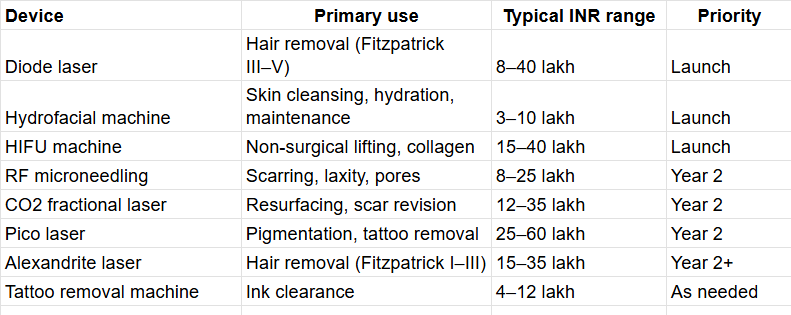
Quick Reference: Aesthetic Clinic Equipment Summary